 Amanda Hocking
Amanda's Blog
Book Bloggers Are People, Too
Okay, I’m writing a blog in a response to a blog, so it might help if you read the blog I’m responding to first. In this case, it’s this blog: ‘Ain’t nothing gonna break my stride’: or WTF YAlitchat.
Several things I want to point out before proceeding: That blog was written by April at Good Books &Wine, a person and blog I am unfamiliar with. I was only directed towards this blog because of somebody else’s retweet.
The other thing is the really important part – I did not and have not read any of the #YAlitchat from February 2nd. It’s because of that that I’ve been hesitant to comment on this blog, but it’s been bothering me for a week now, so I’ve decided that I’ve got to say something.
If you didn’t read the blog (which you should), I’ll just explain the main points. YAlitchit is basically just a discussion on Twitter where people talk about young adult books. It’s pretty self explanatory. According to what April says in her blog (which I have not confirmed), some things were mentioned in the YA lit chit staying (and I’ll quote from her blog):
“People honestly think bloggers don’t sell books. People seem to also think negative reviews are unprofessional.”
“Towards the late middle/end of the chat, the tweets were flying about negative reviews and book bashers and blah-di-blah. If ever there is a pet peeve I have, that peeve is people telling me I can’t write about something I didn’t like.”
“And, OF COURSE we get tweets that seem to me to be completely on the fringe. I.e. ‘bloggers who bash books should be blacklisted‘ and ‘bloggers should never bash an author’s writing”
And again, I’m going to encourage you to read her blog if you haven’t already done so. Go. Hurry. I’ll be here waiting when you get back.
The reason I debated on comment is because I didn’t read the YAlitchat, so I don’t know what exactly was said, and I don’t like commenting on things I’m not certain of, and the reason I don’t go back and read it, is because I knew it would really, really make me angry, and I didn’t want to write an angry rant blog.
But I’m bothered enough by this where I feel like, as an author, I need to say something.
Book bloggers have saved my life. Book bloggers absolutely without a doubt sell books. I can prove it to you. In May, I sold just over 600 books. In June, I sold over 4,000. In May, I had no reviews. In June, book bloggers started reviewing my books.
And the truth, a lot of the reviews I got in June for My Blood Approves were 3-star reviews, and it STILL sold . Because they were solid, well-written reviews that explained what they liked about it and what they didn’t. They were honest, and that’s important, because then readers trust them. Readers won’t buy books from people they don’t trust, and so reviewers need to be honest. They need to say when they didn’t like something. They need to say what they want to say.
Seriously. That’s just a totally insane concept to me. Clearly book bloggers sell books, and they do it all for FREE. They’re only payment is “free” books. Really think about that. Their payment for selling my book is getting to read my book. And they work their butts off.
Writing reviews is really, really hard. I mean in-depth reviews that explain what worked and what didn’t. That’s incredibly difficult. I don’t know how they do it. I couldn’t do it. Nor would I want to. These people are super human.
They’re juggling families and jobs and school and pets and dishes, and they make time in their busy schedule to not only read a book but review it. That astounds me. I’m in awe of their drive.
Julie Brazeal at A Tale of Many Reviews has probably sold at least a thousand of my books herself. She’s been like a one woman fan club. Alex Bennet is my self-proclaimed #1 fan, and he’s only fourteen, and he’s writing blogs, doing video book reviews, going to school, AND on top of that, he’s writing his own stuff. I have no idea how he has time to sleep.
There’s so many more book bloggers, too many to name. (And I’m sorry if I didn’t mention you. My brain shorted out, but I know there’s A TON of you who have helped me, but I feel a bit like I’m about to give an Oscar speech, and they just started playing the wrap up music. My mind isn’t working, but THANK YOU).
And that’s not even counting all the people who take the time to review my books on Goodreads, Amazon, and Barnes & Noble, or all the people I don’t even know about who are telling their friends and family. I get emails and comments from people all the time saying they heard about my books from their friend/sister/daughter/brother.
I honestly don’t believe I’ve ever sold in a book in my life. The book bloggers, the readers, these are the salesmen. These are the people out there selling my books by talking about them honestly. And I am so, so, so grateful for them. Unbelievably grateful.
When I send out ARCs, I want an honest review. That means sometimes people don’t like my books. And that’s fine. I know that when I sent it out.
Book reviewers have to be afforded the right to be honest, even if it means being negative, otherwise it defeats the whole purpose. Readers trust their opinions because they’re honest, and if readers don’t trust them, they won’t read the reviews or buy the books. So nobody wins in that situation. Everybody needs them to be honest, including authors.
Now, I will say that there is a difference between saying “I hated this book” and “I hate the author and think they’re smelly and stupid and hope they die.” And any reputable book blogger would never say the latter, and if they did, authors probably would stop sending them ARCs, as they should. It’s one thing to review a book. It’s another to attack a person.
So, no, I’m not defending personal attacks, but writing a negative review on a book doesn’t equate a personal attack
So that’s all. That’s the end of this. April really said it all best in her blog. I just felt that since book bloggers have done so much for me, I wanted to stand up and say that, as an author, I agree with those sentiments and I support you guys. I know how much work you really do, and I appreciate it immensely.
Indie vs. Traditional
Lately, I’ve heard a lot of talk over the internet about going indie or going traditional in terms of publishing. More and more people are suggesting going indie, while some people still believe traditional is the best for long term goals.
But I’m going to let you guys in on a little secret: This isn’t an either/or situation. You guys are both on the same team – Team Writer.
I’ve talked a bit before on my feelings about indie publishing (see: My Thoughts on Indie Publishing), and my thoughts haven’t changed much over time.
Here are some other things I’m going to say:
I don’t actually know how my sales stack up other authors. I have a pretty good idea how I compare to other indie authors, but I literally have no clue how many books traditionally published midlist authors sell or even best sellers. No clue. So I can’t actually compare my sales to other authors, because again, I have no clue.
I also know that ebooks only make up a small portion of the number of all books sold. Depending on who you ask, that percentage is as low as 8% or as high as 30%. I don’t know the exact figure, but I do know that huge portion is still paperback and hardcover.
J. K Rowling has no books in an ebook format (she refuses), and yet, I would guess (again, speculation, since nobody sends me print outs of their book sales) that she probably sold more books yesterday than I did. Maybe not, but even if she hasn’t, she has still published less books than I have, and hasn’t published anything new in four years, so even if she did sell slightly fewer books than me yesterday, that’s still impressive.
What that means is A) J. K. Rowling is a very good writer, and B) there’s still a lot of sales in traditional publishing. Print is not dead.
What that boils down to is product placement. Paperbacks get more sales simply because they are there. I run to Walmart to pick up socks, and then I see the shiny cover of a new book staring at me from the end of an aisle, and I grab it.
So here’s my theory on the future of publishing, which may or may not be wrong:
This whole ebook thing is going to benefit everyone in a real big way.
Traditional publishers will not die. Some may suffer, most will adapt. As a breed, they will change, but they will not go quietly into that good night.
Indie authors will also continue to flourish. Some with have great success, some will have no success, but most will do moderately well. Writers will be happier because of this, and readers will be happier with more options.
Midlist authors will go almost entirely indie. I think this move with benefit both the authors and the publishers. In a real way, publishers lose money on midlist authors.
Publishers have for years been in the business of making bestsellers. They put all their money and energy into make best sellers, but the problem is, nobody can actually predict a bestseller. People pretend they can, but they can’t really. So sometimes publishers put money and energy into books that were not bestsellers, and because of this, they lost a lot of money.
That meant that publishers had even less money and energy to give to midlist authors, who suffered because of it and had fewer sales, which meant less money for publishers, who then had even less money, and the cycle goes on.
What’s also hard is that most bestsellers don’t come from first time books. Yes, there are exceptions to the rule, like J. K. Rowling and Stephanie Meyer. But most authors start out with moderate sales and they become a bestseller by putting out more titles and building a fanbase over time.
Publishers gambled on new authors knowing that their first book probably wouldn’t be a smash hit but they would grow them over time.
Unfortunately, from what I understand, publishers haven’t had the time or money or maybe just the inclination to do that as much as they used to. Many authors, if their first books weren’t smash hits, were then left without a publisher for future books.
What indie publishing allows authors to do is grow the way they used to with publishers. Authors can put out books and build a fan base. (Or a “platform” for those who like terminology). They can become bestselling authors before a traditional publisher ever works with them.
Because of this, for the first time in history, publishers have a real way of being able to tell if a book will be a best seller. Basically, because it already is a best seller or is written by a best selling author.
You may ask yourself, “But if I already have a best seller on my hands and I am a best selling author, why would I want a traditional publisher? Aren’t they just swooping now that the hard part is done?”
The answer: Ebooks are still only 8-30% of the market. People speculate that in five years it will be 50%, maybe in more than. But for the sake of argument, let’s assume that’s right. If you’re already a best selling author in the 8-50% market, why wouldn’t you want to take a chance on being a best selling author in the the other 50-92% of the market?
Let me put it this way: Being Amanda Hocking right now is awesome. But being J. K. Rowling is out of the world. If you’re an author, and you’ve worked your ass off on your books and your career, why pass on a chance at maybe being J. K. Rowling and settle for being Amanda Hocking?
Also – and here’s the best part – there is no real risk.
I’m going to tell you a story about Ann Author (get it?). She has written an ebook called Bestseller Book. To get a bestselling book, Ann Author has epublished a few other titles, like Not-Quite-Bestseller Book and Another Good Book.
Ann Author’s Bestseller Book gets noticed by publisher Big 6 Trad Pub. They offer her an advance – which at this point, may actually be smaller than what she’d make in 3 months off of Bestseller Book – but it will offer more services to her book, like editing, covers, advertising, and shelf space in brick and mortar stores. This will take some pressure off her, since until that point, she’s had to do all the work herself. Ann Author has also managed to create buzz around herself and her book, along with a dedicated fan base, so Bestseller Book will most likely sell well once it hits stores.
At this point, the story plays out in two ways. One – it all goes well, she sells millions, moves in next door to J. K. Rowling.
Or two – Bestseller Book is not a bestseller book anymore. It bombs. Big 6 Trad Pub actually loses money on her. It’s a sad day all around… or is it?
Because meanwhile, Not-Quite-Bestseller Book and Another Good Book are still selling like hotcakes in ebook format.
Side note: Big 6 Trad Pub may have a had clause in their contract about having first dibs on future works, and this I’m not a complete expert on. But my understanding is that if Ann Author writes another book, she has to show Big 6 Trad Pub first to see if they want it. If they don’t she can go to another publisher and see if they want it, and if they do, she has to go back to Big 6 Trad Pub so they can counter offer before she can take the deal with the other publisher. But I really have no idea how that would work ebooks (and this is why it’s important to have a good agent to make sure you get the best contract with the least restrictions you can!!!).
Even if you assume that in this worst case scenario poor Ann Author has a complete crap contract and Big 6 Trad Pub has the erights to Bestseller Book for the next gazillion years, and she has to play stupid boomerang with publishing clause about future works (which will go quicker if she has a good agent), eventually she can publish more books.
But her other books, Not-Quite-Bestseller and Another Good Book are still paying the bills. This is even better if Ann Author has more than three titles in her pocket when she signs up. And then, eventually, she can go on to write and publish as many books as she wants. Ann Author can continue to be a best selling author, even if the Big 6 Trad Pub thinks she isn’t.
That was the worst case scenario for Ann Author. But the reality is that an author with a number of titles selling well and a large fan base should continue to be a best seller with a large fan base no matter the platform.
That’s how this becomes a win/win situation for writers and publishers. Publishers no longer have to gamble or put money out on books that don’t earn it back. They can pick best sellers from the indie world and do what they do best – sell best sellers in paperbacks and hardcover.
Indies, of course, can choose to stay indie or take offers from publishing. All authors should weigh that choice themselves, based on their own goals and books, because it varies person to person and situation to situation on what is best for an author and their books. But the point is – they have a choice. Ann Author can say no to Big 6 Trad Pub and still be a best seller.
Meanwhile, authors who couldn’t find a home with publishers or have more midlist sales will continue to have sales without fear of being dropped or ignored by publishers.
And readers, who had authors they loved fall of the face of the earth when publishers dropped them, now get to read new works from them, as well as find back-listed titles of old favorites, and find new authors for cheap.
Indie will be a place for authors to grow and flourish and connect with readers in a way that was never possible before. Publishers will publish fewer books and be more selective about it, but they’ll be able to save money and make more money this way.
In the long run, everybody wins. Authors and readers have more freedom than ever before, and publishers have an easier way to sort through the slush pile.
And as for people who say the slush pile is too much for the reader – readers are not idiots. Most really bad indie books are obvious from the go. Without even sampling, it’s pretty easy to spot a book that will be positively dreadful by the cover and description and the other reviews.
Yes, some indie books will have more problems than traditionally published books, especially with proofreading, but if the story is engaging, most readers will forgive minor errors. Most readers are willing to accept an error here or there in return for an engaging story at a low price (though no author should be lazy or sloppy). What readers will not ever stomach is being bored.
And on a final note – indies still need agents, unless you plan on purely publishing ebooks forever. If you ever want to do foreign, film, audio, or any thing else with your rights, including working with enhanced ebooks, you really, really should get an agent.
And to answer a related follow up question I get a lot – agents do not get money from deals they do not broker or their agency doesn’t broker. Meaning I made the deal to publish my books on Kindle and nook myself, so my agent doesn’t get any of the royalty. So don’t worry about an agent messing with your eroyalties. That’s not how it works.
anyone lived in a pretty how town
I like e e cummings a lot. The titles of the My Blood Approves series are all taken from the poem “since feeling is first” by e e cummings.
So I really like this video because it reminds me sort of e e cummings (particularly the poem “anyone lived in a pretty how town, “) and it’s a little steampunk-esque. So it’s fun and pretty and enjoyable to me. As such, I’m sharing it with you.
And I analyzed my writing on some website by copy and pasting five chapters from Ascend, and it says that I write like one of my favorite authors. And it’s since it’s on the internet, it’s completely true and accurate. That’s always fun, right?

The Best Things in Life are Batman
Last night, I dreamt that Joseph Gordon-Levitt and I got a really cute dog. Some kind of pug mix, and it was super cute.
So I woke up today, thinking about what a swell guy Joseph Gordon-Levitt is, and I tried to convince Eric to let me watch Inception tonight (but failed – we’re watching Buried now). And then I learned the most magical wonderful news ever – Joseph Gordon-Levitt is going to be in the new Batman!
Me & Eric are hoping he’s the Riddler, but really, I don’t care what he is as long as he’s in it. (There is actually a video floating around on the Youtube of me drunkenly sobbing over Robin Williams possibly being the Riddler instead of JGL).
I am pretty sure that the third Batman film is going to be the greatest experience of my entire life.
I love Batman. A LOT. Probably too much, but I don’t care.
Some Promo Stuff & Motion City Soundtrack
Some info:
My KTTC interview (the NBC affiliate out of Rochester, MN) will be on Thursday, February 3rd at 10 PM. I’ve been told it with be on the KTTC website at some point, but I’m not sure when. I’ll have links and what not when it is up (assuming I’m not horrible in it).
The interview I did with a reporter for USA Today should be in the edition on sale next Thursday, February 10th. That’s not completely certain yet, but that’s what I’ve heard so far.
And I got this tweet today:
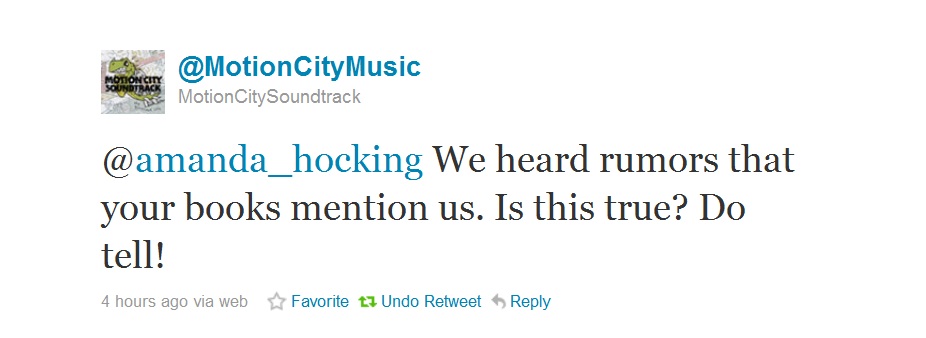
I’m pretty excited about that. I do in fact mention Motion City Soundtrack a couple times in My Blood Approves (Jack and Alice talk about them and go see them at First Ave), and I also listened to MCS a bunch while writing Hollowland (mostly “Disappear”). And I put “Always Running Out of Time” by Motion City Soundtrack on the soundtrack for Honalee.
Now I am going to continue watching Top Chef, and then go to bed.