Amanda Hocking
Amanda's Blog
Until Death Do Us Part
Our short story today comes from David Michael, author of Nostalgia. If you enjoy this story, be sure to check out his site: www.gunsandmagic.com.
________________________________________________
Ross’s memory was fine, and his eyesight and hearing were still in working order, at least on the right side. It was his sleeping that the long years had robbed him of. He used to be able to fool himself and lay abed for the recommended eight hours even if he wasn’t so much sleeping as zoning out, meditating on the back of his eye lids while Marjorie puttered about the house in her morning rituals. Now, though, he didn’t have the patience. When the sun came up, when Marjorie started her morning ritual–especially when Marjorie started her morning ritual–he couldn’t even pretend to sleep.
How many years could one person do the same thing over and over? The dusting was the part that Ross most couldn’t understand. From one day to the next, dust didn’t have time to accumulate, Ross figured. But what Ross could or couldn’t understand or figure out was of no nevermind to Marjorie. She would keep on doing her morning rituals until … forever, Ross guessed.
Or near enough to forever. How many years had they been married now? What came after the so-called Golden Anniversary? Diamond? Or just petrification?
Ross certainly felt petrified as the first rays of the sun peeked over the horizon and through the parted curtains and poked him in the eye.
Parting the curtains of the bedroom window was always the first part of Marjorie’s morning ritual. She got up, stretched with a creaking of tendons and a cracking of bones that was at once awesome and frightening to witness–and had been startling Ross awake since their first morning spent together–and then went to east window and pulled the curtains back with the matching sashes. Both curtains and matching sashes were faded and wearing thin–just like the two old people behind them, and like just about everything else in their little house–but Marjorie liked the material and the print and she refused to get new curtains until she could replace them exactly. Already the difference between the curtains drawn and the curtains parted was getting hard to determine.
The morning sunshine–and the dust put in the air by Marjorie’s morning diligence and worn-out feather duster–irritated Ross’s nose. He sneezed, causing Marjorie to oops! and say, as she said every time he sneezed, “Bless you.”
As he did every time she said that, he looked at her and said, “Hang your blessing, woman. Stop dusting me.”
Marjorie’s thin face took on that hurt look she had perfected over the years, her thin lips pressed together until they almost disappeared, her eyes widening and the tip of her nose trembling as if she might start crying. Then she hmmph-ed and turned her back on him and continued dusting, sending a million shiny motes spinning in the direct sunlight.
Ross rolled out of the bed and stood up. He stretched, creating a few satisfying pops of his own. Marjorie still faced away from him. He put a thin hand on her thinner shoulder. “I’m sorry,” he said. “I’m always grumpy in the morning.”
She turned around, letting his hand stay on her shoulder. “You’re just always grumpy.” Then she went up on tiptoe and pecked him on the right cheek. Her lips were dry and scratchy, just like they had been for … how long? Too long. So he got revenge the way he always did, by kissing her on the forehead with his own dry, scratchy lips.
Marjorie pulled away from him, a tired and faded playfulness in her expression. “Get on with you. I have to finish my dusting.”
Long ago, he would have given chase. Now, though, his gaze fell, as it always did, to her left hand, which she kept wrapped in a scarf and pressed to her stomach. As old and as far gone as they both were, he wondered at the vanity that made her hide her hand. He had given up trying to convince her that no one cared. He certainly didn’t. He actually wanted to see her hand, which she found revolting, and she didn’t care that she could still use the hand. She kept it wrapped in the same scarf, day after day. That argument he always lost. Like so many of the arguments they had had over the years. Not that he actually lost so many of them, he told himself–and had told his dwindling number of friends over the years–he didn’t lose arguments so much as he had learned that winning arguments wasn’t all that useful in the long run. And their marriage had certainly proved to be a long run.
He left her in the bedroom and went looking for breakfast.
The kitchen was spotless, as it was every morning. Not a pan in the sink, not a plate out of place.
And, as usual, no breakfast.
That was one thing that had changed. She used to make him breakfast every morning. Even on the mornings he got up late and she had to tsk-tsk him about how retiring hadn’t meant he didn’t have work to do. But then, just like Marjorie could no longer find the material to replace her favorite curtains, what he wanted to eat just wasn’t available any longer. He couldn’t muster any interest in the food she cooked for him. He would just sit at the table, look at the steaming piles of food she had cooked, never taking a bite until she took the plate away and scraped it into the trash. Eventually, she stopped making breakfast for him. He didn’t blame her.
So, as he had every morning for–how long? way too many–years now, he went and sat on his favorite chair on the front porch and watched the drones heading to work, reveling in the last bit of entertainment his retirement left him.
The drab men and women in their threadbare work clothes walked mechanically along the road, stepping around the rusting hulks of the old cars on their way work. Some of them saw him step out of his front door and looked up. But, as always happened, their interest faded in an instant, and they continued along their way. None of them so much as waved in greeting.
Ross took some satisfaction that everything had gone to hell after he had retired. Otherwise, that would be him out there, slogging along to a job he hated, probably walking miles that used to seem so short but now stretched into eternity. If he got to work during daylight hours, he would be sitting in a cramped cubicle, staring at a dark monitor until the sun went down. Then he would get up, and walk back home. And when he got home, he would wait until the sun rose to do it all over again.
After a few hours, her morning ritual completed, Marjorie came and sat down beside him. That she sat on his left now was also a change from how things used to be, but she didn’t want him to hold her left hand. Only her right hand.
So they sat there, holding hands, watching the damned, some of them with kids in tow on their way to days at school as dismal as those of their parents at work.
Ross found himself looking down at Marjorie’s left hand, still wrapped, resting in her lap. After he got over the initial horror of what he had done to her, and their lives had returned to a semblance of their old routine, Ross had found the sight of the bare bones of her left hand oddly fascinating. That, as much as simple vanity, he figured, was why she kept it covered. Her skeletal hand was the only time in their many years together that there had ever been any violence.
She didn’t blame him, and she had shushed all his apologies. She figured she had made him pay sufficiently by flattening the left side of his head with her favorite iron skillet and locking him in the garage until she had died of the festering wound he had torn with his teeth–he still remembered the sweet, sweet taste of her flesh–and then awoken hungry just like him. When she let him out of the garage, they had first looked at each other as if to find the best place to attack with their teeth, then they had hugged each other as tight as they had ever had. Since neither one wanted to eat the other any more, they made up.
And then they had gone out to look for dinner together. Along with the Pulvers next door–Hank Pulver with half of his face missing–they had searched every house in the neighborhood, finally finding that repulsive little punk Bobby Jackson–Bobby had more than once thought it the height of humor to throw rolls of toilet paper over and into Ross’s hedges and trees–and cornering him in an interior bathroom. Ross remembered wishing he had thought of this particular revenge years before, when Bobby would have been even more tender and tasty.
Those had been happy days, when there were still living people to find and eat. But then the last of the living had been devoured or had died of their wounds and come back as undead.
After a only few more months of chaos, life–or un-life, Ross thought–had gone back to normal. In a manner of speaking.
At least he and his good wife had retired before it all went to hell. Because his own little corner of hell wasn’t that bad, since he owned his house and had Marjorie with him. It was too bad about the grandkids. He missed them sometimes.
The two of them sat and watched the drones trudging by until long after the sun went down.
________________________________________________
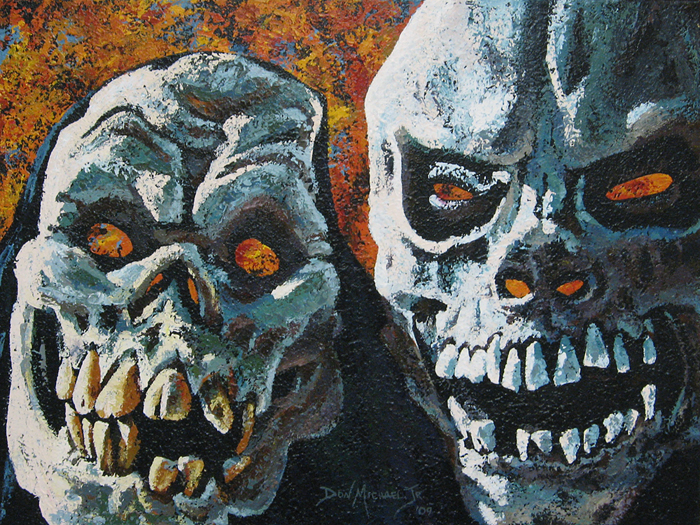
Inspired by this painting by my brother, Don Michael, Jr:
Happy Birthday, Eric
Zombiepalooza has the pleasure of having a short story from J. Dean. J. Dean is author of the fantasy novel The Summoning of Clade Josso: The First Descent into the Vein, and other various stories, many of which are found on smashwords.com. He can be reached through http://enterthevein.blogspot.com
______________________________________________________
The door interrupted the silence with two heavy thuds, causing Aunt Sarah to jump from her living room chair. Eric looked up from the multicolored, interlocking columns and stretches of blocks that served for his protective fortress, keeping the mammoth one-eyed teddy bear from slaying the green army inhabitants within the plastic walls.
“They’re back!” He called, a joyous grin spreading the corners of his mouth.
Melissa set the Shakespere book aside, careful not to bump the kerosene lamp as she did so. “Calm down!” She scowled. “You knew they would be.”
The little brother bounded off the floor, oblivious to his sister’s dour words. He took his position by the descending flight of stairs that let to the below-ground garage entrance. Surfacing from the doorway was the face of Aunt Sarah, pale and thin, her black hair mangled and knotted, laced with strands of silver. Behind her came another face, smothered in a red beard, bearing two green eyes that still carried their polished sparkle.
“Hey-o, Eric!” Uncle Rollie called. He hefted a thick, brown box in his hand. The boy frowned, looking past his kinfolk, into the shadow of the foyer beyond.
“Where are mom and dad?” he asked with a falling tone. The smile melted into a concerned, open mouth under wide, frightened eyes.
“They had to take a different way back.” Uncle Rollie replied, following Aunt Sarah up. “We were separated at Pine Street. But they’re fine, okay? I just talked to your dad, and he and your mom will be back within the hour.”
That eased Eric’s mind-a little. He hated them being out there, without Uncle Rollie. Not that Dad was a wimp or anything: he could handle problems. But still, Mom and Dad out with Uncle Rollie made all of the unease go away. Uncle Rollie could handle anything. After all, it was his house that Eric and his parents ran to. Even when the first signs of trouble had started, there was no discussion, no listening to the news, no talking with the neighbors. Mom and Dad had made the announcement without a second thought: Pack what you need, son. We’re going to Aunt Sarah and Uncle Rollie’s house for a while.
They had arrived, and Uncle Rollie had welcomed them in with open arms-and with plenty of protection.
Aunt Sarah passed in front of the bay window, now covered with an array of two by fours that Uncle Rollie and Dad had put up, permitting little more than slits of morning sunrays through the cracks. She held a smile, but Eric couldn’t help feeling sorry for her. Her smile didn’t hold the… what was it? Strength! Yes- It didn’t hold the strength of Uncle Rollie’s. “Melissa,” she began with a weak voice, “would you brew up some coffee for us?”
Eric’s cousin-a spitting image of a younger Aunt Sarah, though without the tired, aged look of her mother-answered with a silent nod and a turn towards the kitchen.
“So,” Aunt Sarah said as Uncle Rollie set down the large box, “Have much trouble?”
“Not too much. We spent most of our time on Cherry and Monroe. Only saw about a dozen total. Even when Kate and Peter started off on Pine, I didn’t see too many of them up that way.”
“Did you get anything?”
“Some stuff. Found four packages of frozen chicken down at the Colvin’s residence.” He winked at Eric, “Hope you like it fried, buddy.”
“Sure do!” Eric grinned back.
“Nobody at their place, I take it?” Aunt Sarah asked.
Uncle Rollie pushed a thick hand through a bushy, ruddy cap of hair. “At the Colvin’s? No. Either they got out of here in a hurry, or… well, you know.”
Aunt Sarah looked away. “I can’t believe we haven’t seen anybody else.”
“What about those people from last week, Uncle Rollie?” Eric asked. “The four men with the guns like yours?”
The big man crouched in front of his nephew. “They weren’t good men, Eric. Not at all. That’s why your dad and I had to scare them off like that. They wanted to hurt us. Not everybody we meet is going to be good, Eric. Like we explained to you earlier, some of them are using this bad time to do bad things. You understand that, right?”
The youth gave an understanding bob of the head. “Good!” Uncle Rollie sprang up, “Which reminds me: you have a birthday today, right?”
Eric’s eyes widened in realization, looking at Uncle Rollie, then Aunt Sarah, then the carboard box which stood about as tall as he was. “Is that for me?” He gasped.
Before Uncle Rollie could answer, Eric flew to the box, pushing his fingers through the gaps, giving the top flap a furious tug. Uncle Rollie approached to help, flashing a Swiss Army knife that sliced through brown cardboard and the red, white, and blue decal featuring the torn logo of a department store. The outer layer came off, revealing white styrofoam that gave way in the form of irregular shards as a result of Eric’s demanding pulls and rips.
The child’s face brightened at the sight of the naked present: long, dark, with a beautiful blue that coated the barrel of steel, merging with a deep red wood in the stock. Elegant and sleek, it gleamed in the orange glow of the lamps: a masterful work of craftsmanship.
Eric picked it up, careful to keep the end pointed down, as Dad and Uncle Rollie had cautioned him many a time, “Is it really for me, Uncle Rollie?” He asked in awe.
The older man nodded. “Happy Birthday, Eric.”
The child gave his uncle a sheepish grin, then walked over and wrapped a free arm around the big man’s thigh. “Thanks, Uncle Rollie.”
“You’re welcome, kiddo.” Rollie patted his head, then turned toward his wife. What little remained of Sarah’s smile disappeared into a look that barely kept back the tears.
Eric took hold of the weapon once more with both hands, throwing a glance at the stairs leading to the upper floor of the house. “Can I try it out, Uncle Rollie? Please?”
“There’s a box of .22 longs under the towels in the closet. You know how to load it?”
A depressed thumb released a small black box from the underside. Eric caught the magazine before it escaped, holding it up with confident accomplishment. “Just like yours, Uncle Rollie.”
“Yes,” Rollie murmured with a satisfied nod, “Just like mine.”
A clatter of excited steps boomed up the stairs. Rollie moved to the front bay window, peering through a spot between two of the boards that permitted a glimpse of the front yard and the street beyond. In the glare of the morning sun, four figures shambled down the street, their clothes and skin drooping and ripped from their bodies.
“When I was his age,” Rollie began in a soft, somber tone, “Our dad bought me a model airplane for my birthday. Greatest gift I’d had, until Peter broke it.” He added with a chuckle.
A thin, bony hand touched his shoulder. “Are they really alright, Roland? Or did you just tell Eric that to make him feel better.”
He turned to face Sarah, “No. They’re alright, really. Peter’s got a whole satchel full of shells with him. If I don’t hear from them by afternoon, I’ll go back out.”
“I don’t like you doing that.” She muttered, “For that matter, I’d rather you went with them.”
“I know. I said as much to Peter. But he and Kate wanted to make sure that Eric got his present. Don’t worry; they’re smart. They know how to avoid infection.”
“And what about the Raiders?” Sarah shot back, “Raiders aren’t slow and stupid! Those four who showed up: If you and Peter hadn’t come-“
“They’ll be fine, okay?” Rollie placed both hands on her shoulders. “Peter’s got the other walkie-talkie, both have fresh batteries, and both have a good range.” He pressed his lips to her fatigued forehead. “Now, would you go get me some coffee, hon?”
She closed her eyes, bowing her head against his shoulder. “Sure.” She whispered. “Eggs as well?”
“Sounds good. Sunny side up.”
Aunt Sarah returned to the Kitchen. Rollie watched her go, then returned his attention to the gap of light filtering through the window. One of the shambling figures had stopped, turning toward the house. Rollie could see more detail: dark attire-looked like a police or security outfit-with a gadget-filled belt around the waist. A black, bloodied gouge occupied the right forearm, while the left hung to the side in a lifeless droop. The face sported deep, crimson smears on the mouth and nose, while the top of the tilted head sported lifeless eyes, devoid of pupils.
A sharp crack could be heard through the house. Outside, a faint cloud of red billowed from the forehead of the figure, which in turn collapsed to the sidewalk in a truly lifeless heap.
“Happy birthday, Eric.” Uncle Rollie whispered.
Angela and the Zombie Village
For Zombiepalooza, author Jason Letts contributed his YA short story Angela and the Zombie Village. For more information about him and his Powerless series, visit his site: www.powerlessbooks.com
__________________________________________________
Somewhere along the east coast, a rabble of zombies built their community in the grime and muck of a shrouded marsh. Between black, muddy huts, rough passageways were carved into nature’s wallowing world away from the light. They gave their disordered colony the unimaginative name of Zombie Village, a place where they could exist in peace without the interference of humans. In this town, the zombies went about their undead business, which would seem completely incomprehensible to any human who laid eyes on it, though no human ever had.
Zombies are essentially anomalies of nature, trapped in animation long after they should have been laid to rest. Only people who die on All Hallow’s Eve with an intact body become zombies. Morticians and morgue attendants know this to be true because bodies vanish at the slightest inattention. Still, personality and memory are lost, as if the spirit has escaped and left the body to toil onward.
These conditions explain why very few zombies exist to share such an infamous fate. One might pop up one place, another somewhere far away, and so it is very rare for zombies to have known each other in their previous lives. And the odds of it being someone close are next to nothing. And it would be unthinkable for an entire family of zombies to exist.
In Zombie Village, however, it just so happened that there was a group of four zombies who had once been a family. A formerly happily married couple, a boy of twelve, and a girl of ten sit around a makeshift table of collected garbage and sticks. They had been doomed to an eternity of semi-life after an assailant entered their home while attempting to satisfy a drug addiction. The man left, no bodies were found, and no one knew what had happened to them. Now they feed in the dim gloom after spending the night aimlessly maneuvering the nearby sludge, their faces blank as a new canvas.
In their new, undead existence, zombies utilize a guttural form of language, stripped to the bare essentials. Words are never wasted, and this economy-driven speech applies to names as well. Forgotten names are replaced with monosyllabic utterances. The only zombie in existence that this did not apply to was the ten-year-old girl, who retained a necklace with the six letters of her name on it.
Angela was unique among zombies for more than her name. Far more astonishing was the heart that still beat in her chest. While her family members were murdered on that blustery and cold night, the single gunshot she took never actually caused her to die. Maybe whatever force draws the curtain of gray over these creatures couldn’t bare the thought of leaving a poor girl alone and in pain. It malevolently claimed her too.
Contrasting the black strands around her, Angela’s silver hair hung down on her worn and sullied clothing. Her skin was as pale as the rest, and her movements and reactions just as slow. Spiders and centipedes crawled all over her fingers before she felt the first tickle of their presence. Her state had so dulled her senses that she didn’t even know she was any different from the rest.
It had been her job to collect food for those she lived with for as long as she could remember. Not that she could put it into words, but she always wanted to do a very good job and bring them the best food possible without hurting anyone or anything. She liked wandering alone in graveyards, preferring to serve brains of the dead rather than those of the living. Her ability to sense things in the dark without seeing them was uniform to all zombies, but more than the ripples of sensation she received, she most enjoyed the freedom. No one would know if she decided to turn left or right or wherever she pleased before she returned to the empty dirt paths and oozing hut walls of Zombie Village. As long as she carried enough food for them to eat, she could walk for quite a ways without anyone criticizing her.
“More,” gurgled her brother, Dar. The carcass of a fish lay in pieces before him. The skull had been cracked open and cleaned out. Flies surveyed the remains.
“Look,” replied Angela. She reached into her pouch and removed a lifeless frog. It lay still in her hands, as if it had never moved on its own. A frog would be a nice treat by any zombie’s standards. Had the parents not been engaged with the rotted brains she brought, it would have been likely for one of them to try and steal it.
Dar snatched the frog from her hand and began greedily ripping at it. Angela watched him. Only a few worms remained in her pouch. Moans and groans drifted in through the door-less entranceway, momentarily distracting the foursome from feeding. They watched a small group hauling a decaying deer into a nearby hut. Mud covered its hide, but each member of the hunting party glared at it with fixated anticipation. This was a boon for them beyond comprehension.
Angela turned back to the people who had been her family. Dissatisfaction contorted their faces. The paltry scraps in front of them now seemed both unappealing and insufficient in light of the neighbors’ gluttonous meal.
“I want that!” accused Gam, the adult male, who was writhing with anger.
“Sorry,” Angela retorted. Her pupils dilated and the rising and falling of her chest quickened.
“You done bad,” he growled. Angela looked over at Dar. He had been looking at her, sitting very still. She couldn’t tell if he condemned her also. Set, the adult female, bore a look of hatred so intense her entire body shook. It is hard to say if the response perfectly matched what she felt or if her body acted on its own.
“Get more now,” Set demanded, the tone of her scathing voice threatening violence. Angela rose and stalked out of the hut as quickly as she could. The piercing glances burned into her back.
Others occupied space in the cramped passageways between mounds. She tried to avoid them, slipped, and fell at their feet. She pulled herself up and continued on. The feeding frenzy next door came into view and she felt something. It was not about the deer but about what had just happened to her. She didn’t understand the sensation in her body. The food she had brought would have been enough for them.
The unknowable feeling persisted as she trudged through the swamp. She walked through a vacuum of sound and movement. She put one leg in front of the other and walked father than she had ever gone before. The ground firmed under her feet, and the sky seemed a bit lighter. The urge to turn around came over her, but it was too late. The air carried strange sounds that enticed her to go on. They didn’t sound like they were made by an animal, but the ripples were continuous and somehow appealing.
She turned a corner and emerged from the foliage. Before her was a sight that took her breath away, leaving her mind blank with astonishment. Angela gazed at a giant spinning wheel of lights that looked like it reached to the tip of the moon. The music from the accordion and the carousel intensified and her stare gradually declined to ground level. A mob of human beings wandered the grounds together. They trapped themselves in the shiny, glowing machines only to emerge moments later as completely different people.
The wheel looked magical to her, and the urge to be closer to it overwhelmed all of the obvious danger. She wondered how something like that could exist. She couldn’t remember ever encountering a structure with a purpose other than to provide shelter. Ducking under the tape, she met with the crowd, ready for whatever happened, even the end of her existence.
“Hey you! Get away from there!” A voice shouted at her from a nearby booth. An attendant gave her a critical look and reached for his radio. A voice from the crowd piped up.
“I told those idiots at the dunk tank there was a leak! Now look you’ve gone and slipped in the mud,” said a large woman who waved away the curious attendant.
“Your hands are freezing!” she said, pulling her hand away after trying to take Angela’s.
“Now that I notice it, you look like you’ve already gotten sick. I’ll take you to the medical tent and we can find your parents and get you some help.”
“Not sick,” Angela said, and the woman gave out a big laugh and pushed her forward along the gravel path. Angela kept her eyes on the ground. She was scared people would see her and know she was different. The woman quickened her pace as they got to the medical tent. She got the attention of a nurse who looked at Angela with scrutinizing eyes. He reached into his bag for a piece of equipment. The woman also peered into his bag, and while they were both distracted, Angela disappeared.
Slipping in between the oblivious carnival patrons, Angela milled about the grounds trying to figure out which path would take her to the monstrous wheel that towered overhead. Its light shined down on her and made her feel light, like she could float into it and it would hold her and nurture her. Every instant though she expected for a scream, a yell, some sound of utter disgust. She was not like the other children who frolicked and played.
To her left she spotted a small stand adorned with colorful pictures. An artist sat on a modest stool and sketched a caricature for a patron. Angela stopped for a moment to settle her confusion. She couldn’t understand why a drawing should exist. It served no purpose to her. You could not eat it to satisfy hunger or hide behind it for protection. And yet the colors reached out to her eyes and again she had the unnamable feeling. The fake smiling faces touched her without moving or threatening her. There was a safety somewhere within their charcoal and acrylic eyes.
A flush of fear came over her and she moved on, wary of staying anywhere for too long. She passed by games and rides, simple amusements that stamped peoples’ faces with a single look. Cheeks were raised, jaws slightly open, eyes wide. They smiled. The noises that came out of their mouths also mystified her. They were laughing.
She began following a small group of people who led her to the Ferris wheel. A threatening attendant managed the ride and she shuddered with anxiety over what might happen to her. He opened the gate and began admitting passengers into the rotating compartments. Her group reached the front of the line and she ran out and got in. The others didn’t know her and assumed she was with other people. The attendant hadn’t noticed and he looked into the dark cabin, realized someone had already gotten on, and rotated the wheel to position the next cart.
Sitting on the cool, steel bench, she held her knuckles to her mouth with her elbows on her knees. She wanted to be imprinted with that look, the smile that would make her human and make everything come alive for her. She wondered when it would happen. The thumping in her chest made her shake.
Suddenly, her compartment began to rock and she realized she was trapped. The door didn’t open when she tried it, and then when she looked through the window she discovered she was so high up that her body would break if she fell. Her mind went blank and she was sure she would be caught.
She had heard stories about things humans did to catch zombies. Members had left Zombie Village and never returned. It all became so clear to her that she was not caught earlier because the humans were ushering her into this giant machine to dispose of her. They had all known. Soon everything would be blank and she would return to the dust of the earth. Her realization paralyzed her and she glared out of the window as the forest and the ocean came into view.
Nothing made sense as she swirled around in the giant machine. It was a mistake to come and soon this little life that she had would be extinguished. The ride stopped and the door opened. The attendant stood there, obviously daydreaming, and behind him stood impatient people waiting in line.
A smile burst from her lips as it dawned on her. The machine had been terrifying, but it had worked and now she was human. Climbing out of the chair and onto the ground, she looked down at her hands. They appeared the same to her, grayish and decaying. Angela accepted that her appearance remained unchanged and believed that only this flood of emotion marked her transformation. Without fear, she milled about the grounds and took in all of the exotic sights and sounds. They filled her with joy, like they were little pieces of magic that jinxed her with their own little feeling of happiness.
Her eyes caught a small wooden stand in the corner. It looked forlorn despite the beautiful flashes of color decorating it. The flowers of red, yellow, blue, and gold drew her in close enough to faintly smell their sweet fragrances. She placed her hand on a soft petal and the sensation was like it was talking to her body. She loved that they were alive too and she felt a connection between them.
An old woman abruptly regained consciousness in a folding chair near the stand. Thick glasses grooved her nose and gloves covered her hands despite the heat.
“How long have you been here?” she asked, a little surprised.
“I don’t know,” Angela replied. She inspected the stand for a short while before thinking how these plants had never been seen in her village and realizing she needed to return to her home. She slowly backed away from the stand.
“You don’t have any money, do you?” the old woman asked.
“No,” Angela replied.
The old woman reached into her bag and produced a small envelope. It had a pretty picture of a pink flower on one side and words on the other. When the woman held it out to her, Angela took it in her hands and inspected it. Tiny specks inside rattled back and forth. Again, the ends of her lips curved.
“I knew you would like that. Take care, dearie.”
Angela walked away. She turned to look back on the place she visited, one more fantastic than anything her limited imagination could have envisioned before. Fewer lights glimmered in her eyes, and most of the rides had stopped. A glow bloomed inside of her and it stayed with her while she disappeared through the forest and into the swamp.
Forgetting that she had been sent out to find food, her preoccupied mind wondered how she would keep her secret. Angela practiced making her face blank and draining her voice of any tones or inflections. She tried to tell herself she was tired when she wanted to jump. She wanted to slow down when everything was happening so fast.
Entering Zombie Village, she felt as afraid of the other zombies as she had about the humans when she first entered the carnival. She kept her head down in the dim twilight and tried not to be noticed. It felt cold to her, the blackness everywhere. She noticed the lack of color and the lack of life like never before.
Only when she walked into her hut and faced the three individuals standing there waiting for her did she feel the gravity of her mistake. She did not bring back any food and that would lead to trouble. The adult male did not need to ask to know she had failed. The rage bubbled through him. In desperation, Angela held out the small envelope to him, hoping anything would happen. Sensing its insignificance, he ripped it in half and flung it through a gaping hole in the wall. It emptied itself of its seeds in the air and floated down to the ground.
No words exchanged between them, yet the result was understood. The three of them stalked out into the passageways in a manner that was universally recognizable among zombies. Sensing the impending hunt, other zombies gathered around and followed them into the open swamp. By the time they left, not a zombie remained in the village. The massive horde marched out into the darkness, intent on satisfying its one intrinsic need.
“No!” Angela pleaded. She slithered around inside the aggressive throng, yelling to anyone who would listen. The zombies moved in a direction that Angela had never been before and she wondered if it was intentional. She looked and listened as hard as she could for food sources to slow their progress, but she perceived nothing.
“No!” she said again, fighting her way to the front. The swamp must have been narrower on this side because they had already reached firmer ground. The trees thinned and more moonlight shone down from above. Angela felt nervous. A flush of dread overcame her. She had no idea where they could find a substantial enough food source.
The mob came upon a solitary cabin. The house in clear view view, they now marched on cut grass and climbed through wooden fences. Angela strained her neck looking for a graveyard, hoping it would be enough, wishing they would all turn around and leave. Moving her legs as fast as she could, she struggled closer to the front.
But finding a graveyard was not the intention of the group. They could smell their food in the air and they zeroed in on it with swift precision. The sound of laughter and happiness rang bittersweet in Angela’s ears. Intermingled with voices, the sound of splashing sifted through the air. A hedge enclosed a backyard swimming pool. Its occupants wouldn’t be able to see what was coming for them and the zombies could emerge simultaneously from three sides, ensuring no chance of escape.
The zombies silently took their positions for the ambush as they shimmied through the cedar hedge. Angela opened her mouth to scream but a slimy hand covered it. Another took hold of her and pulled her back. She could see through the hedge. A small number of humans waded in the water. They bobbled a beach ball, blissfully unaware of the overwhelming likelihood of their imminent deaths.
Another feeling came over her, one more intense than any she had felt before. Their life suddenly seemed so precious. They had infinite opportunities to express their heart’s deepest desires as they created a life that stood for what they believed in. She saw a man, a woman, and a few children who could surround themselves with a beauty matched only by their limitless spirit, their lives threatened by a senseless twist of fate.
Angela struggled and broke free only to hear her screams echoed by those in the pool. The water made a swishing sound as the humans clamored for the steps. The delirious, brain-craving zombies emerged on the cement and shuffled closer to their imperiled victims.
Angela outflanked the other zombies and ascended first onto the patio, where she saw the huddled family clinging to each other, trying to open the door. A streak shot through her, and the faint pulse of her heart offered a vision of herself and the three zombies leading the pack. They had been a family once and the closeness tingled inside of her and fluttered her eyelids. She turned back to the attackers, her parents and her brother.
“Stop! We can’t!” she cried out. Her words fell on deaf ears. Zombies attempted to scale the sides of the patio as the humans struggled to dislodge the jammed door. The zombies on the stairs quickly ascended, forcing Angela to back up until she was nearly on their victims herself
.
“We are a family! Believe me! Stop!” she screamed with all of the emotion and courage her heart could contain. She let it bleed out through her voice and the words popped like fireworks in the air.
The zombies continued to press closer and they lunged for their attack. Though her brother Dar had tried to save her, Angela bore the brunt of the first wave clawing as she shielded the huddled, moaning humans with her small body. The cuts ran through her and a new sound caught the horde’s attention.
Her chest torn open, Angela’s beating heart was exposed to the starry night’s sky. The sound struck the zombies’ attuned ears and they peered down at the red organ palpitating in a black mass, its last few beats petering out.
“Now I’m everything,” she said in the silence and stillness. The blankness came over her and her head fell back. Before she became the dust of the earth, her mind received the image of a torn screen and the sound of a starting engine.
No ritual and no ceremony were performed for Angela. No tears were shed for her and no solemn words shared. The horde returned home, leaving her body where it had fallen. They continued their existence just as they always had. Zombie Village, however, irrevocably changed from the dull, dreary place it had been.
Her seeds, the object of her emerging fascination, germinated and spread throughout the alleys and crevasses. At first, the zombies embraced the crooked thorns and brambles, believing them to be a reflection of themselves, but the first bloom of the radiant, pink Swamp Rose shocked them and left them mesmerized by the bold explosion of the vigorous spirit of life.
Monsters vs. Zombies
Zombiepalooza gets a classic monster mash-up from author Robin Reed with Monsters vs. Zombies. If you enjoy the story, be sure to go to www.barstowproductions.com for more information.
____________________________________________________
As the sun died behind the Pacific Ocean, breakfast stumbled across Sunset Boulevard.
It was a little early for the man to be so drunk, Tomas thought, but if that made it easy to grab a quick bite after waking up on this fine Los Angeles evening, he wasn’t going to argue. Jokes aside, alcohol in a victim’s bloodstream didn’t even give a vampire a buzz. Undead livers don’t process liquor or anything else.
From a rooftop, Tomas kept his eye on the prize.. As soon as he was sure no one would see, he would snatch the victim up and drain him. After that light aperitif, he would perform the most important function of any vampire’s day – making sure he looked good – then proceed to some serious hunting.
He felt Kamaria approach from behind. She put a hand on his shoulder. “You can do better than that one,” she said.
“Just an appetizer,” Tomas said.
She laughed that delightful laugh, in which he could hear the soul of ancient Africa. Every time he heard it, he shivered with the freedom she brought to him as he rode in a wagon, purchased like livestock, chained, and on the way to a life of servitude.
Picking his moment, when the drunken man paused in an unlit space between street lights, Tomas glided down to claim his first meal of the night. He took the man under his arms and flew up to another roof, a favorite feeding spot behind a five story billboard where the latest big movie release was trumpeted to the world.
Before he even put his victim down, he knew something was wrong. The smell of a living human being is intoxicating to a vampire. It is the smell of life, of energy, of another night of immortality. This fellow was rot, and ruin, and real death rather than undeath.
Tomas backed away from the thing. Normally he would bitten the man’s neck and sucked the lifeblood from his veins very quickly. He couldn’t imagine doing that. The victim reeked, and it wasn’t natural decay. There was an emptiness in the thing, a lack of the glorious life and soul that usually came with the blood.
Kamaria landed under the movie billboard and asked, “What’s wrong?”
“He’s…dead,” Tomas said.
As if to argue the point, the man turned towards the two vampires. He wore a suit, and it was still neat. He hadn’t been this way for long. He seemed about to speak, perhaps introduce himself. The sound he made, though, was inarticulate, a grunt combined with a moan. His nose was missing.
“Ugh,” Kamaria said. “It’s a demon. No, I sense no taint of hell. I have never seen its like in all my years.
That was saying something, Kamaria’s years went back to a time when all the people of the world lived in Africa. Tomas had known her for almost three hundred years, but he often felt like a child next to her.
He realized he shouldn’t have taken his eyes off the man to look at his lover when his left hand exploded in pain. “OW!” he shrieked, in a very un-vampire-like way. The thing was biting him!
It didn’t bite for long, partly because it backed off with an expression of disgust on its noseless face, and partly because Kamaria backhanded it so hard that it’s head almost came off. Attached by the spinal cord alone, the man looked behind himself and upside down for a second, then turned and walked backwards, mouth chomping at nothing.
“Get rid of it,” Kamaria said. Tomas lifted the thing from behind and threw it off the roof.
“Look at this,” Kamaria called. Tomas went to her. She stood looking over Sunset Boulevard. A group of humans – and humans they were, they gave off the fresh healthy scent of blood – ran down the center of the street. Tomas realized that there was no traffic. He should have noticed that earlier. Hunger must have narrowed his focus too much.
More slowly, some of the dead things pursued the humans. Tomas’s enhanced senses saw what the humans did not, that they were running towards another pack of the dead. Death both chased and awaited them, and they would not escape.
“Should we…save the humans?” Tomas asked. “These things are some sort of cousins of ours, predators of the living.”
“They are nothing like us,” Kamaria said. She very rarely became emotional, but he sensed a rage boiling within. “Vampires are civilized monsters. We do not destroy the entire species. Look further, see the city these things have made.”
From the Sunset Strip. set on the side of a mountain, the view of Los Angeles was usually a thing of beauty, with lights in square patterns that stretched to the sea and to another set of mountains far to the south.
Large sections of the light grid were dark, and fires dotted the valley floor. Smoke obscured parts of the view. The new monsters caused more than death, they were chaos incarnate.
Kamaria launched herself towards Sunset Boulevard, with Tomas following. They tore into the packs of dead things, tearing off heads and limbs with abandon. Most were quite fresh, but some seemed to have crawled from the grave. They felt no pain, and no injury seemed to stop them.
Then a snarl and an animal stench filled the air. Something else attacked the walking dead, something with teeth and claws. It went for the heads of the things, tearing into the brains until they fell and stayed down.
When no more dead stood, the werewolf turned to Tomas and showed its many teeth. One fang gleamed gold in the streetlight.
“Lazarko,” Tomas said. The wolf formed into his human shape, a plump, balding businessman from the Russian community in West Hollywood. Somehow Lazarko always returned to human form with clothing on, plus a number of gold chains around his neck. An expensive gold watch gleamed at his wrist, and the golden fang became a human canine tooth, still made of gold.
“You gotta destroy their brains,” Lazarko said. “That’s the only way to kill ’em.”
“What are these things?” Tomas asked.
“Where have you guys been? Oh, right, you don’t have cable news in your coffins. The TV is calling them zombies. It started this morning. Dead people all rose up and started eating living people. It’s all over the world, too.
“Too bad the humans all escaped,” Kamaria said. “I’m working up quite an appetite.”
Tomas shook his head. “We’re saving humans, yet still need to feed on them. I’m confused.”
“These – zombies – must be stopped,” Kamaria said.
“Good luck with that,” Lazarko said. “I’m going to find a place to hide.”
“They will find you,” Kamaria said. “You are human most of the time.”
“The first one I found didn’t like the taste of me,” Tomas added. “I bet you are pretty tasty. You can’t be a wolf all the time.”
“Hi guys!” A voice said behind Tomas. He knew this voice, and wished he didn’t.
“Hi, Greg.” Greg was from the other major community in West Hollywood.
Kamaria gazed at the new, transparent addition to their party. She didn’t share Tomas’ dislike of the ghost, she said she had known many like him, both alive and dead.
“Too bad what’s going on, huh?” Greg asked. “All the underworlders are upset. The goblins in the park, the trolls under the freeways, even the movie producers.”
“You give me an idea, Greg,” Kamaria said.
“Really? What?” Greg the Gay Ghost said.
“We must summon the monsters, the shades, the demons. All those who live on the edges of the human world and want it back the way it was.”
“Cool.”
“We enter the underworld, and bring all its denizens together in this cause.”
“That’s impossible.” Lazarko waved his hands to emphasize how impossible this was.
“It must be done.”
Tomas said, “Kamaria has a lot of contacts in the underworld. If she says that’s what we do, I’m with her.”
The ebon vampires, the werewolf in the gold jewelry, and the gay ghost posed dramatically for a few seconds. Then Tomas asked, “How do we get there?”
“I have my SUV.” Lazarko pointed at the giant vehicle he had left at an angle in the middle of Sunset Boulevard.
The monsters set out to save the world in a Cadillac Escalade.
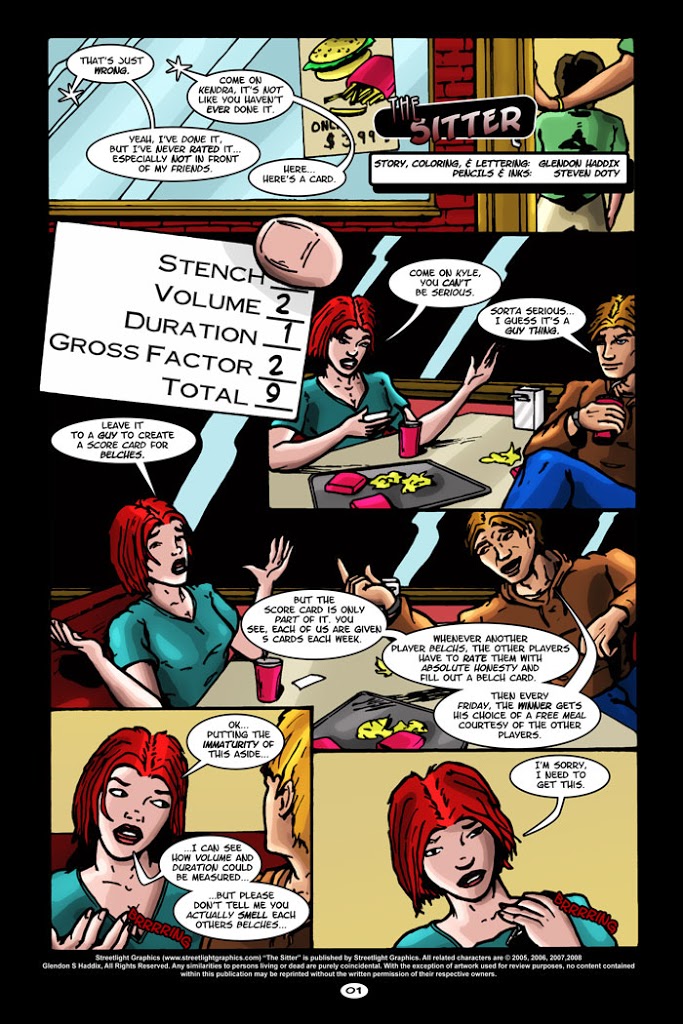
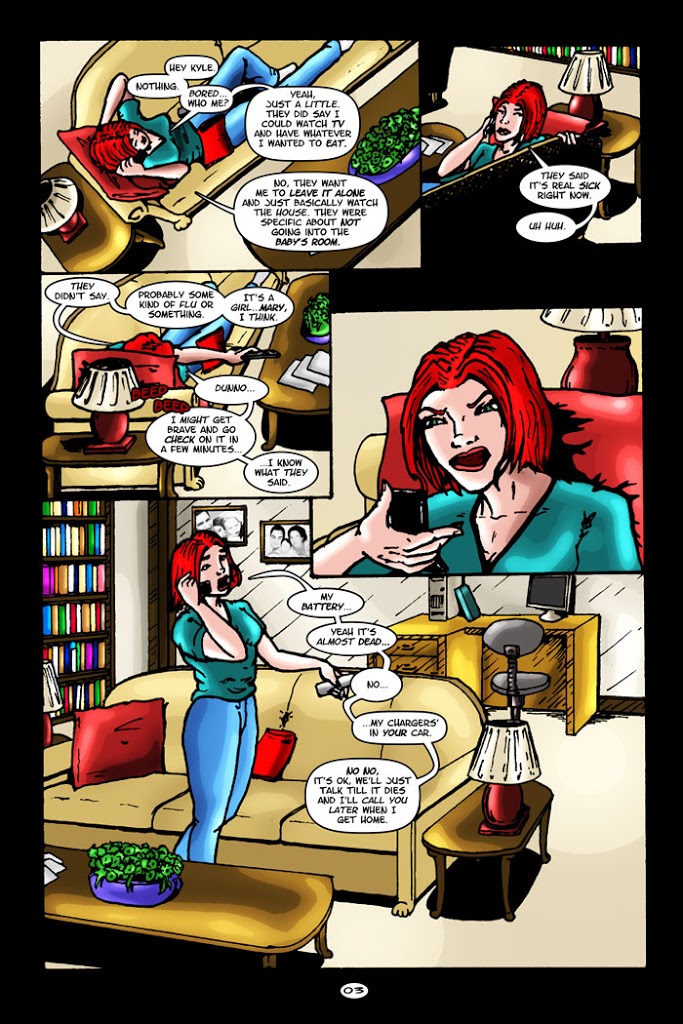
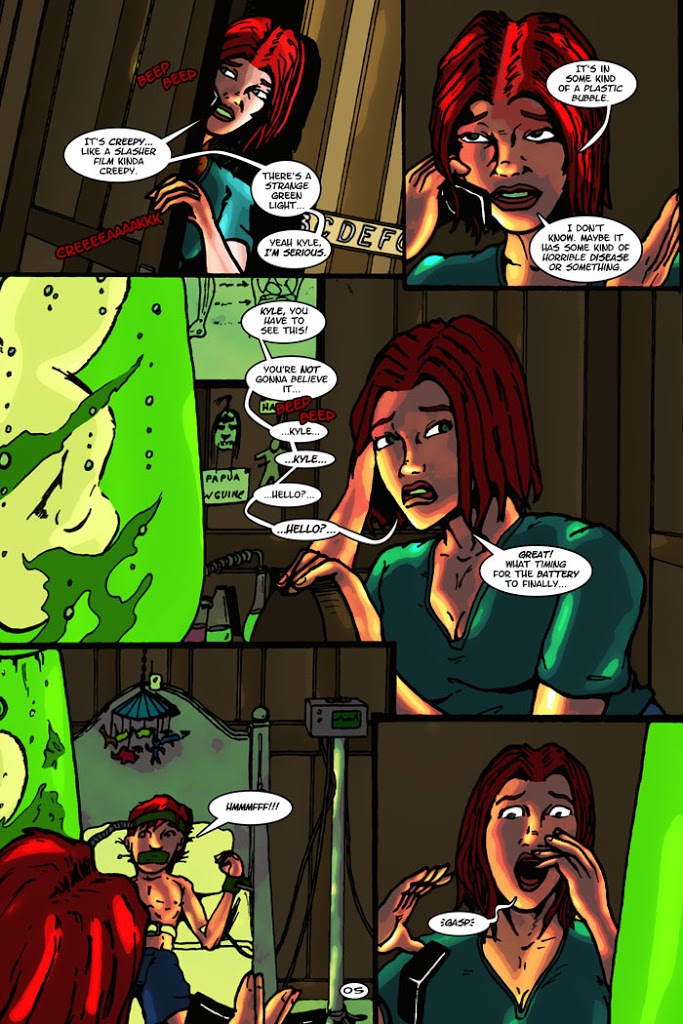
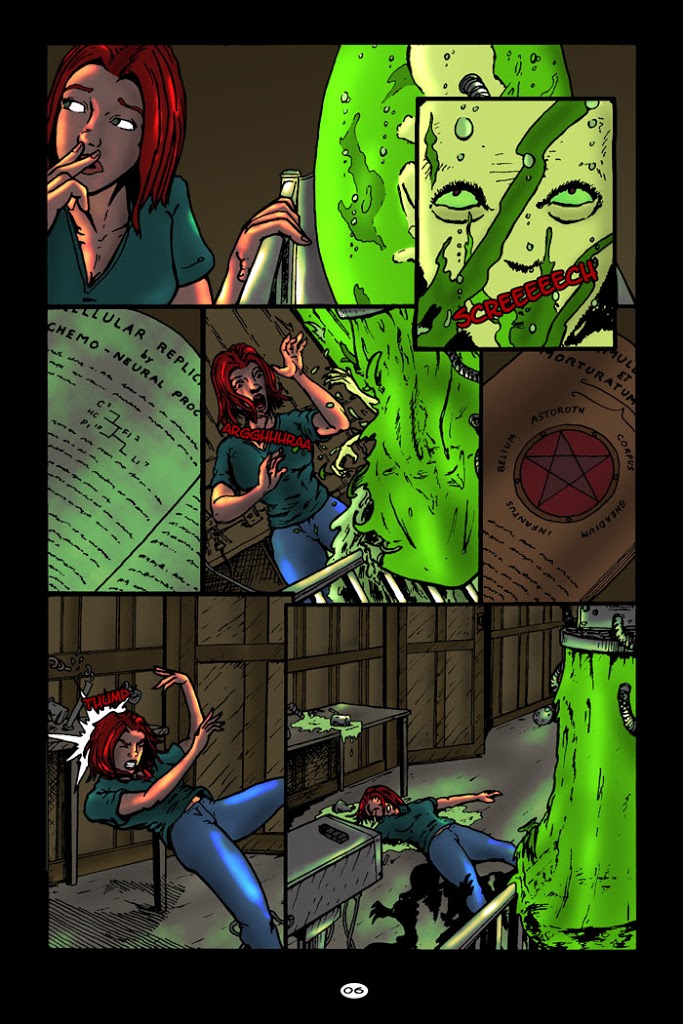
The Sitter
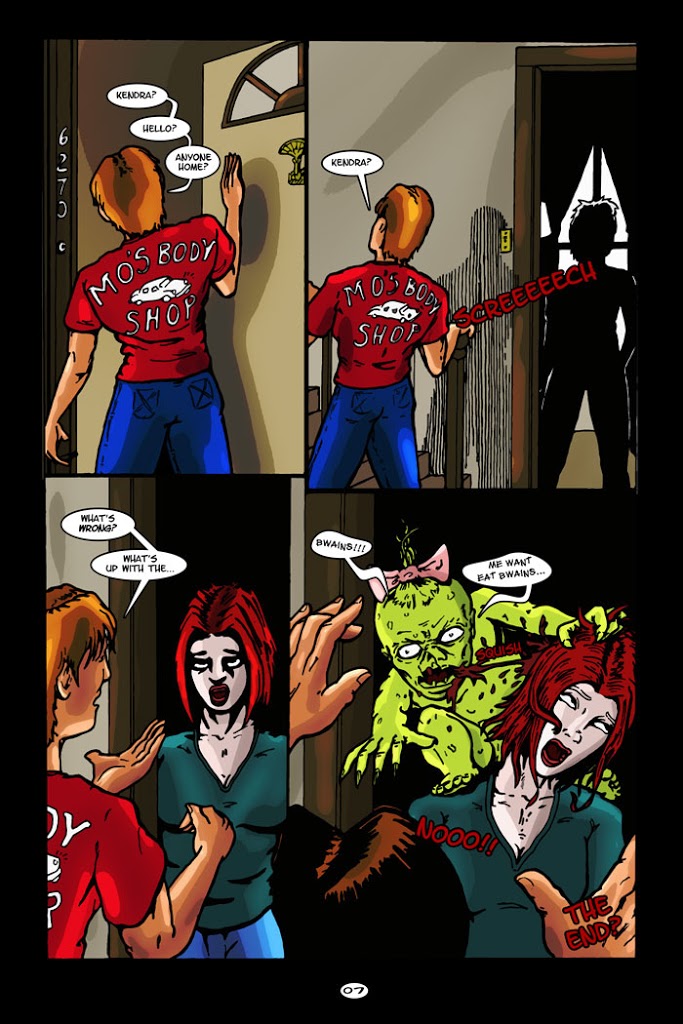
The creator of the fantabulous Zombiepalooza logos, Glendon Haddix, has made a quick zombie comic strip. As a comic aficionado, I’m pretty stoked about this one. For more information about Glendon Haddix and his creations, please check out: www.streetlightgraphics.com While you’re at it, you might want to check out his wife, author T. L. Haddix’s site with info about her series: www.tlhaddix.com
You might want to zoom in to read the text. The perimeters of my blog didn’t allow me to make it any bigger, but the story’s worth zooming in for. Trust me.
Without further ado, here’s the comic: